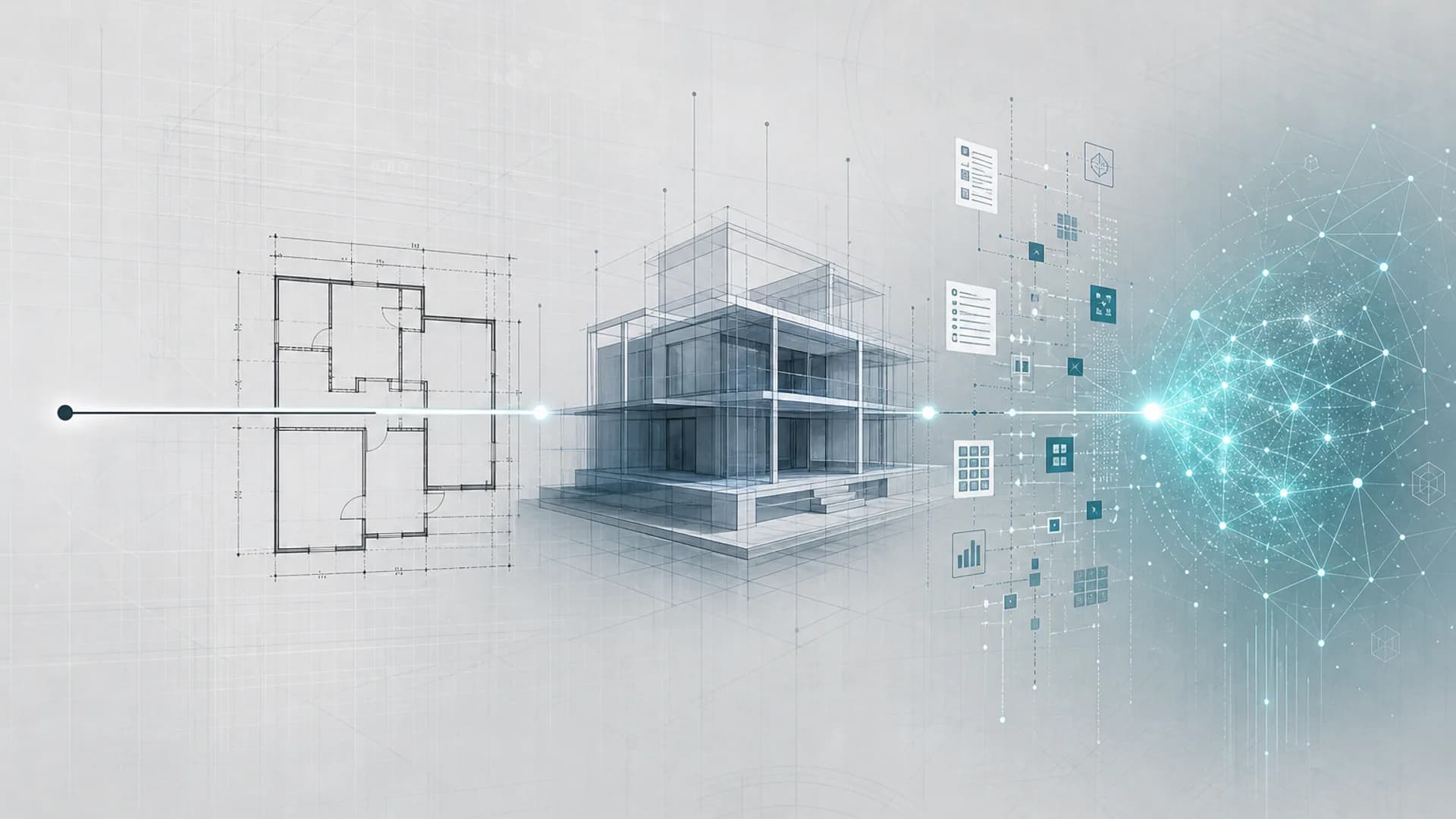
It all starts with a point in empty space. Then another appears, and another, until they form a continuous line. That line can be drawn on a two-dimensional plane. That is where many of us discovered CAD. At the time, AutoCAD seemed to be the norm, the universal language. But sooner or later, 2D falls short. The need arises to see more, to understand space, to walk through it. And 3D appears.
3D changes the way you think. You realize that 2D is nothing more than different views of something three-dimensional. And then the inevitable question arrives: what if that geometry could hold information, parameters, intelligence? That is the moment BIM appears.
ArchiCAD shows the way first, but Autodesk reclaims the lead with Revit. And a different stage begins: it is no longer just about drawing or modeling, but about understanding how the software works on the inside.
Over time a new need appears: automation. There are repetitive tasks that take time away from what really matters. And because computers are good at that, you look for ways to hand them off. Dynamo is often the first door. You start connecting nodes, understanding flows, solving problems without writing a single line of code.
But there comes a point when Dynamo feels too small. Not because it is bad, but because it wakes a greater curiosity: what if I can create my own nodes? What if I can control everything with more precision? That is when Python appears. And with Python comes pyRevit. And with pyRevit comes a new world: Revit's ribbon, its API, its classes, its internal logic.
That discovery changes your perspective. You understand that if you learn C#, you can build native tools that are faster, more powerful, with better interfaces. You can build plugins that not only solve problems, but feel like part of Revit itself. And when you master that, you are already at another level: you no longer just use the software — you extend it.
And then another inevitable question appears: if C# and Python are backend languages… how do you actually master the backend?
That is when databases enter the picture. You discover SQL, PostgreSQL, MongoDB. You learn what a CRUD is, how to structure data, how to protect it, how to design models that scale. You understand that controlling your data is controlling your tools. And that security is not a detail: it is part of the design.
Over time another piece of the ecosystem appears: Power BI. You realize you can not only store data, but also analyze it, visualize it, and turn it into decisions. And Speckle appears, showing that data can also travel, transform, and connect across platforms without friction. BIM stops being a model: it becomes a flow of information.
But the path continues. One day you discover that everything you do locally can also live in the cloud. That Autodesk has an entire ecosystem built for that: APS, Autodesk Forma, APIs, web services. And you realize your knowledge is no longer limited to your computer: now you can create tools that work for anyone, anywhere.
At that point another inevitable question appears: if I can program on the server side, what about the client side?
And that is when you reach the frontend. You discover that JavaScript is king, that HTML and CSS are its inseparable companions, and that frameworks like React let you build modern interfaces without dying in the attempt. And the best part: JavaScript also lives on the server thanks to Node.js. Suddenly, you can build full-stack BIM solutions, from the database to the final interface. You can use APS, web-ifc, three.js… and create tools that once seemed impossible.
When you get this far, you already have everything you need to be a BIM developer. Along the way other words become part of your day-to-day: Docker, Git, GitHub, Vercel… all pieces of the same puzzle.
And then the final question arises: where does AI fit into all of this?
The answer is simple: everywhere.
AI is the advantage that did not exist before. It can help you learn, understand concepts, discover technologies, write code, document, test, deploy. You can leave it on autopilot — though that is not recommended — or you can work alongside it, with you orchestrating and it executing. Some will say that is not programming.
That is why learning how AI works — its models, its limits, its vulnerabilities, its tools — is part of the path. Because this new era does not only accelerate learning: it also opens the door to something bigger. Moving from the monopoly of proprietary software to personalized software, created by the user, adapted to their needs, built with free tools and amplified by AI.
In the end, everything we talk about is just tools. Today we use some, tomorrow we will use others. What matters is understanding conceptually what we do, building judgment, choosing well, solving real problems, and optimizing time and resources. Only by doing, trying, and getting things wrong do we evolve as BIM developers.
We set the limit ourselves.
It does not start with CAD or end with AI.
It starts with you.
And it goes as far as you decide to take it.